



Rose Horowitch’s cover story for the August issue of The Atlantic makes a blunt claim about American reading. The ability survives and the appetite has gone. Her headline evidence, taken from the National Endowment for the Arts, is that fewer than half of American adults read a book of any kind in 2022, the most recent year the survey covers.
The figures under the headline do more work. Sentences in New York Times bestsellers are about a third shorter than they were a century ago. The share of thirteen-year-olds who say they rarely or never read for pleasure rose from eight percent in 1984 to twenty-nine percent in 2025. Horowitch frames all of this as a drift back toward the oral cultures that preceded the written word, which is the most useful idea in the piece and the one almost nobody has picked up.
The reception went somewhere else, into a familiar account in which attention has collapsed and the machines are finishing what the screens began.
Every version of that reading places the change inside the reader. Once literacy is treated as a possession, any shift in reading behavior becomes testimony about the person holding it, less patient and less serious than the people who came before. We call this mood attribution, the habit of converting a material condition into an interior state. It is the default move in trend interpretation, and here it is being applied to an entire reading public. A change in where cognitive work happens is being reported as a change in the quality of the people doing it.
What reading actually is
Reading has never been contained inside one skull. It is an arrangement of people and objects. A book holds language outside the body. A citation allows a second person to inspect the first person’s claim. An edition number and a page exist so that an argument can be located by someone who was not present when it was made. The reader supplies interpretation while the system around the reader holds the object still.
That last condition is the one now changing. The consequential shift is not from books to screens. It is from stable inscription to generated restatement.
Bruno Latour called the objects that gave print its authority immutable mobiles, inscriptions that travel across distance without altering. Two readers on opposite sides of an ocean could argue about page 214 because page 214 was identical for both of them. The page gave the disagreement an address.
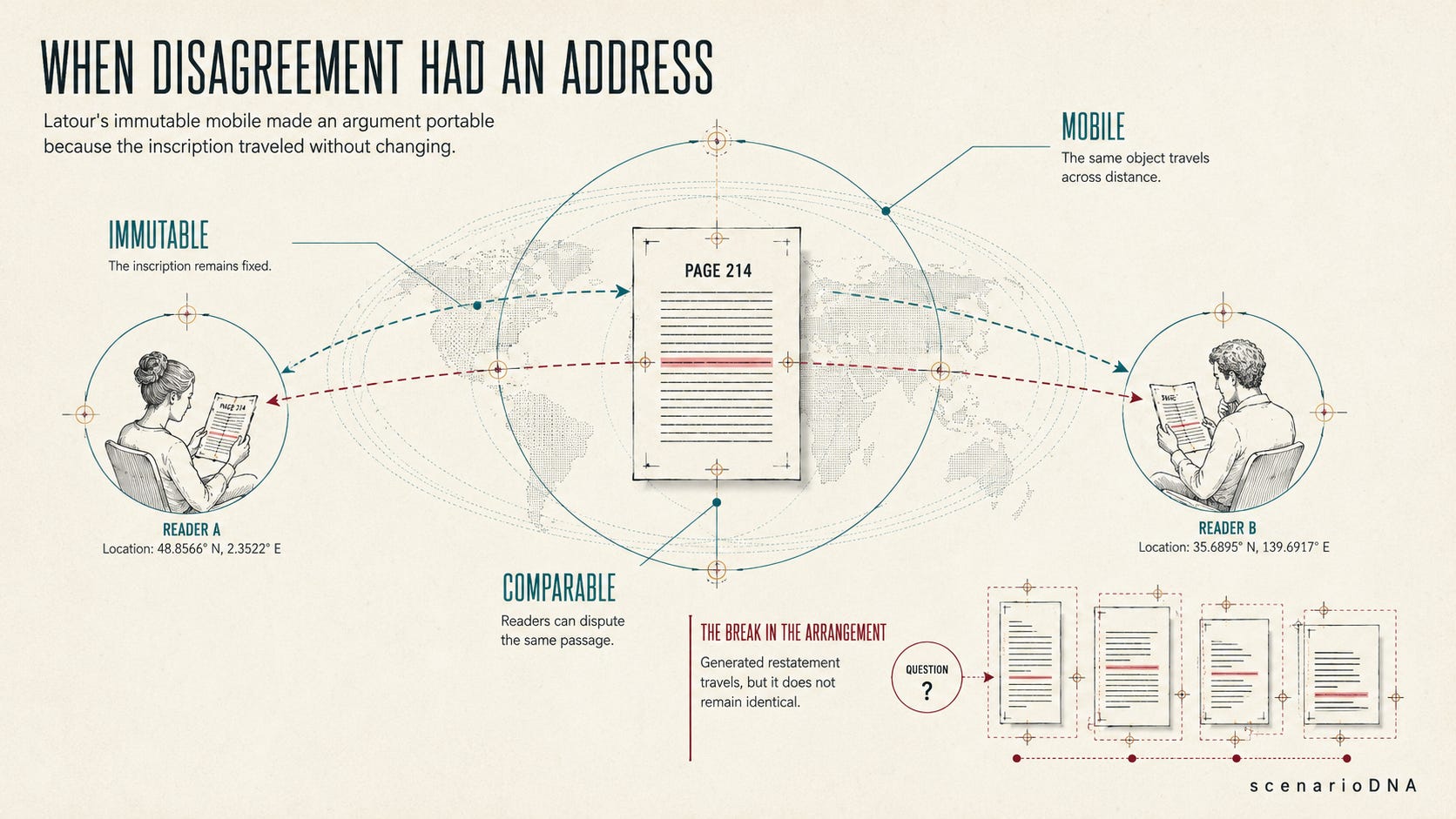
A generated answer has no address. It is produced on request, shaped by the wording of the question and by whatever the system retains about the person asking. Ask twice and the emphasis moves. Two people asking the same thing receive two objects that cannot be set beside each other, because there is no side.
People are still reading. What they read has stopped holding still.
The interface assigns the work
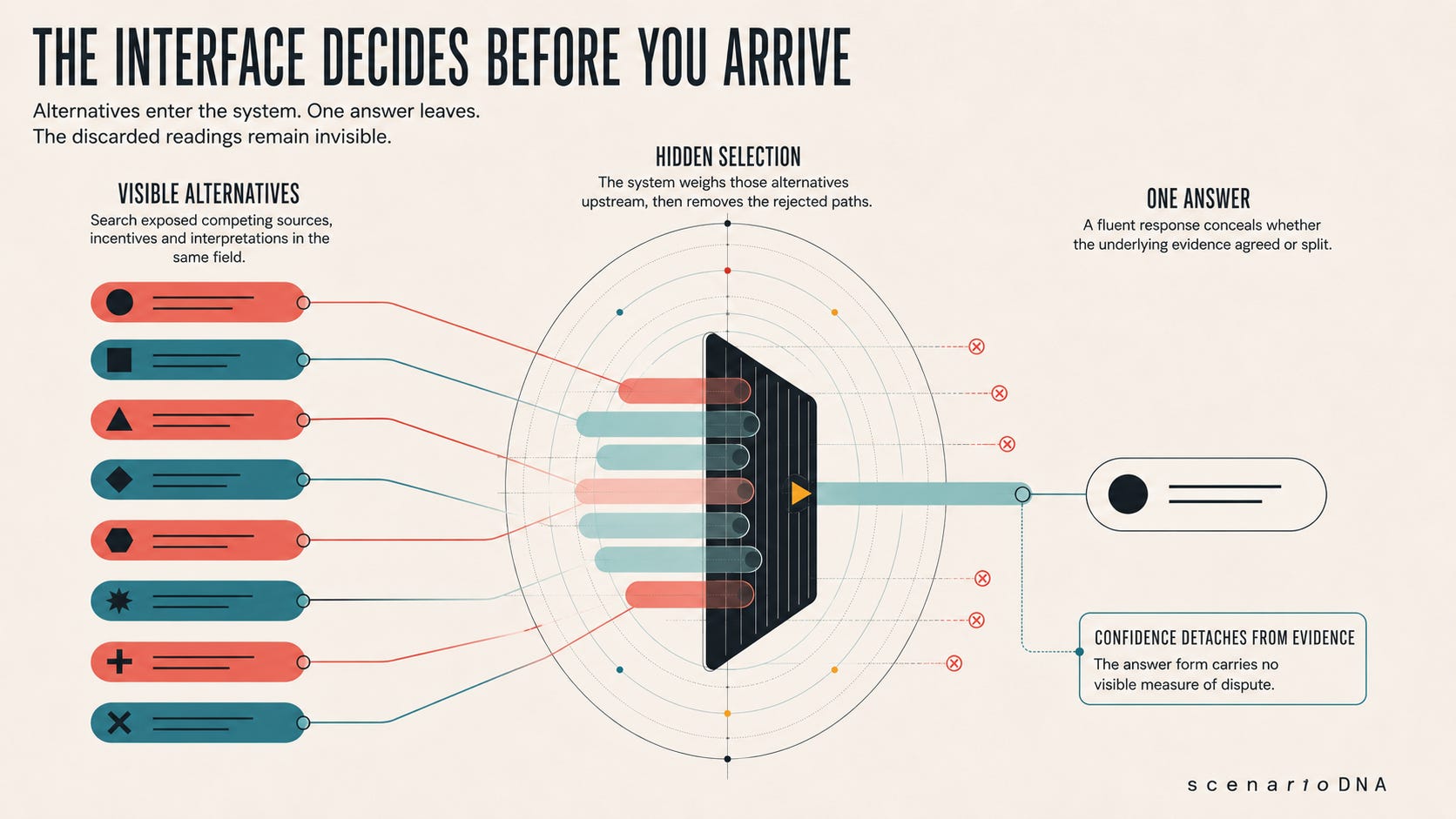
A page of search results displayed alternatives. Its ranking was compromised by advertising and by optimization, and the alternatives still arrived together. The user chose which trail to follow, so the page staged interpretation as a selection among possibilities.
An answer engine displays the selected sequence. The competing accounts were weighed inside the system and then discarded before presentation.
Take a commuter deciding which water bottle to buy, the sort of question that used to produce a page of contradiction. A magazine test, a forum thread full of complaints about a leaking lid and a ranked list funded by affiliate commissions would appear together, and their disagreement was visible in the clutter. An answer engine returns a paragraph naming two bottles. The affiliate arrangement behind the list has been absorbed into that paragraph without surviving as a mark, and so has the forum complaint.
Pew now puts the share of American adults using chatbots to search at forty-two percent. This is the ordinary retrieval path for a large part of the market.
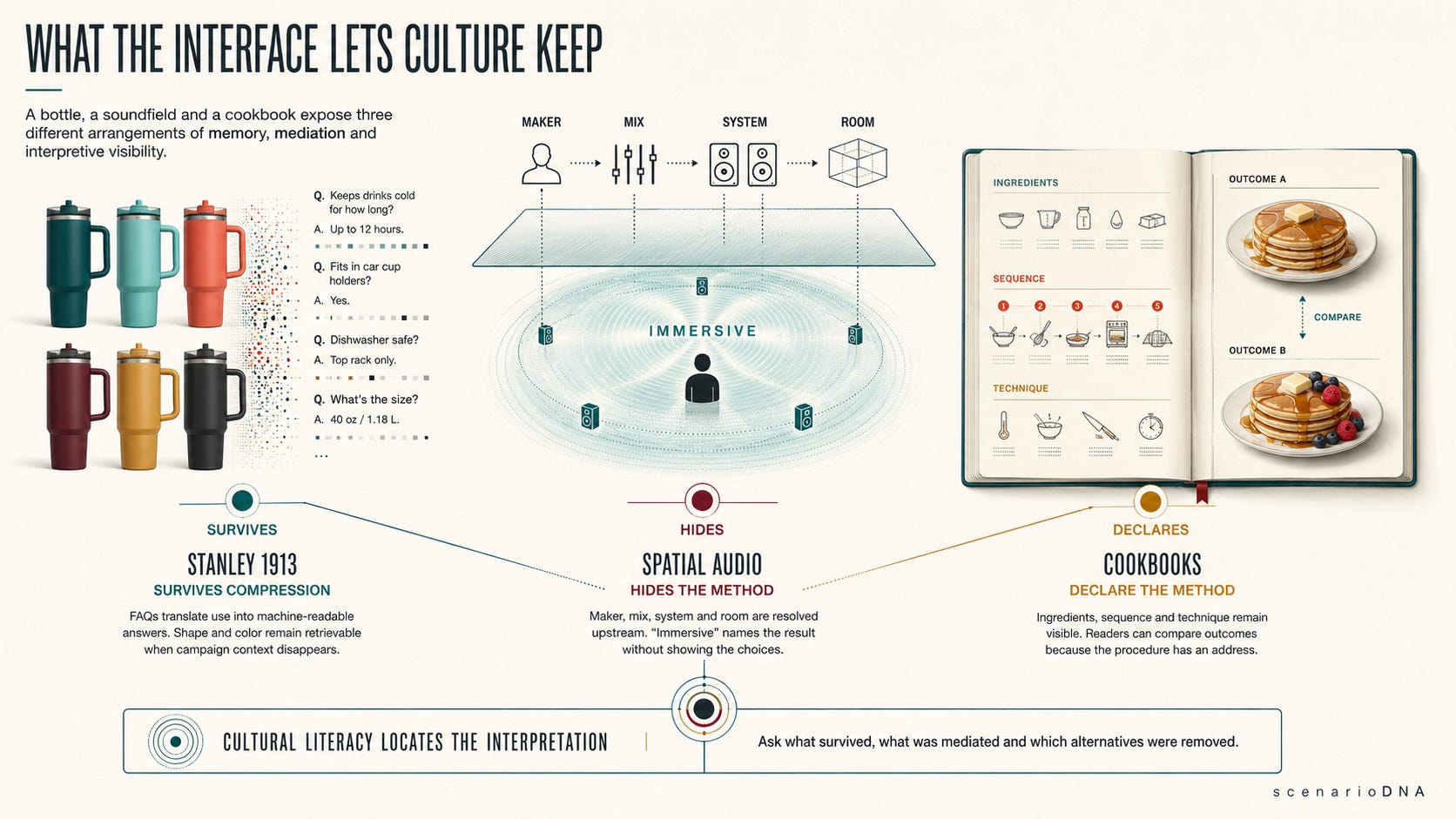
Stanley 1913 has read the consequence faster than most. The company is rebuilding its product information into FAQs, care instructions and usage guides organized around the questions people ask about gifting and travel. Its chief brand officer, Kate Ridley, describes the goal as translating the brand’s experiences into natural-language answers without losing the human touch. The influencer imagery that built the Quencher was made for people, who take meaning from a face they trust, and none of that survives extraction into a text index.
Confidence detaches from evidence, and nothing has to be fabricated for the effect to appear. The answer about the water bottle arrives in the same steady tone whether the reviewers agreed or split, and no word in it marks which was the case. A contested figure and a settled date come out in the same voice. The disagreement was resolved before the reader arrived, and the resolution carries no trace of the argument that produced it.
Spatial audio runs the same operation in a medium with no text in it. We noticed "the pattern" in work for our luxury audio brand client, and the vocabulary is where it shows. Listening has always been divided among the mix, the playback system and the room a person is standing in. All reproduction is mediated, and the difficulty begins when the mediation stops declaring itself. A setting labeled “immersive” or “room-filling” offers an already-resolved account of space, and the listener meets the resolution without meeting the choices that produced it. Interpretation happened upstream and then arrived as experience.
The cultural cost is larger than the commercial one. Competing readings stop being available as possibilities, and nobody rejects an interpretation they were never shown. Public argument changes shape when two people are responding to different generated objects whose selection processes cannot be compared.
Provenance becomes a sign type
Print carried evidence of its own manufacture. An edition number and a printing error guarantee nothing about the truth of a book, and they tie the text to a history of production. Generated prose can imitate the appearance of documentation while holding no causal relation to what it describes. It arrives fluent and without residue.
This is why provenance marks are multiplying. In January last year, the Authors Guild introduced a Human Authored certification with a numbered mark and a public database. The program is easy to dismiss as guild politics or as an authenticity premium. It is better understood as an attempt to restore a missing sign type. The mark makes no claim about whether a book is good. It says the text has an origin that can be checked.
Three further misreadings
The volume error assumes there is less text. More of it exists now than in any prior society, and a growing share is written for machines. In late July, Time began placing advertisements inside the markdown versions of its pages, written for AI agents rather than for human readers. Perplexity blocked them on August 11 and called the practice deceptive. The publisher is now maintaining one textual layer for readers and another for the systems that will restate its pages to them.
The substitution error assumes that formats replace one another. Pew’s April survey of book reading found sixty-four percent of American adults reading a print book in the previous year, with thirty-one percent reading an e-book and twenty-six percent listening to an audiobook. Audiobook use has more than doubled since 2011, and three-quarters of adults read in some format.
The American Booksellers Association counted 605 independent bookstore businesses opening in 2025 against 65 closing, though the openings include pop-ups, mobile sellers and online stores. None of this cancels the decline in reading for pleasure. Formats are accumulating and recombining.
The novelty error forgets that print performed a redistribution of its own, weakening oral recall while producing private reading and standardized knowledge. Horowitch concedes the point herself by quoting an Atlantic article on the same anxiety published 126 years ago. The question worth putting to any media order is which work moved, and what became harder to inspect once it did.
What this asks of brands
Horowitch reaches for Walter Ong, whose account of oral culture repays being carried further than she takes it. Societies without documents held knowledge in formula and in the fixed epithet attached to a name. Swift-footed Achilles is a storage device. The tag traveled because it was compact enough to survive retelling by people who had never met the poet.
Machine restatement reproduces that condition, and it promotes the brand from symbol to infrastructure. When an intermediary compresses everything written about a company before a person encounters any of it, the assets that survive are the ones that were never carried by prose. Stanley's own case shows the split: the campaign photography does not reach the answer engine, while the silhouette and the color of a Quencher are recognizable across a room with no word attached. A word can be taken by anyone, as the audio category demonstrates. A shape or a sound is harder to appropriate and cheaper to recall. This is a claim about memory rather than taste, and the asset that survives compression carries more weight than the paragraph explaining it.
Provenance is the next demand. When the surrounding environment cannot certify origin, proof of contact becomes something a buyer will pay for. Expect the present vocabulary of authenticity to harden into marks and records, and expect tone to matter less than documentation.
The opportunity sits in what the interface throws away. Answer engines remove the alternatives that produced the answer. An organization that puts them back offers something the channel structurally cannot: a comparison that includes competitors, or a published account of why one option was rejected. That is a positioning decision, and it is available now because so few categories have taken it.
The counter-risk arrives with the opportunity. Companies rewriting themselves for retrieval will converge, because one schema rewards the same declarative sentences and the same evidence formats from everyone who adopts it. Distinctive language reads as friction and gets removed. Brands become easier for machines to read and harder for people to tell apart, and the web fills with organized sameness.
Where literacy lands
For a person, literacy under this arrangement includes noticing that an answer arrived pre-selected, and asking what was removed on the way.
An organization can make a test of it. Ask an answer engine the question a customer asks before reaching you, then ask it again from another account in another city. Read the two answers side by side. Whatever holds steady across both is the part of the brand doing the work, and whatever moved between them was not. The page has stopped holding still. A brand is the fixed point a company builds in its place.


